

Making Dinner
And Other Acts Of Radical Resistance

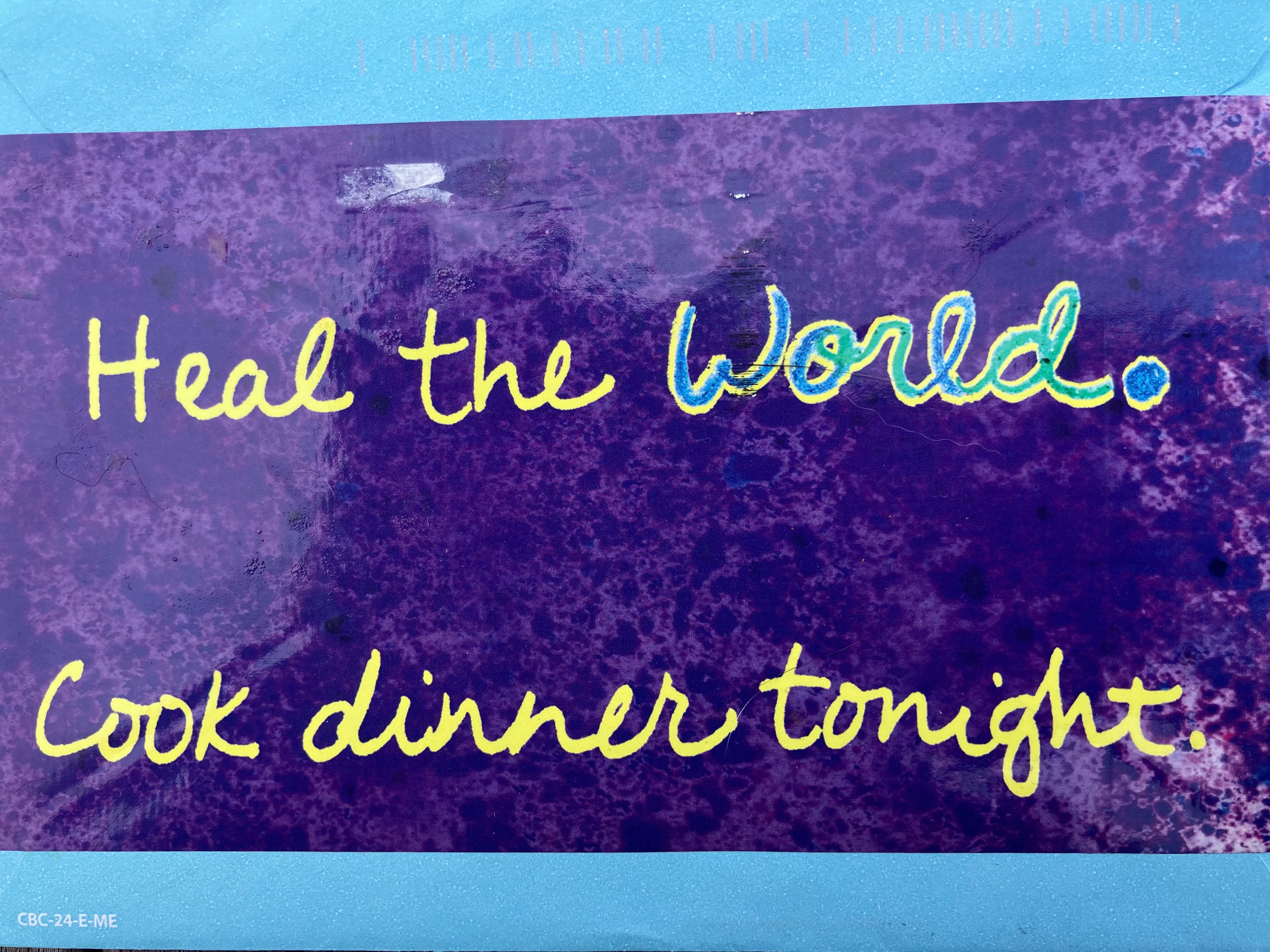
A couple of months ago, a friend sent me a birthday card with a big sticker on the back of the envelope that said, “Heal the world. Cook dinner tonight.” The envelope has been propped up on my desk, leaning against the wall so it’s the first or second thing I see when I go into that room.
I believe that directive is literally true. And when I mention “radical resistance” in the subtitle above, I’m not talking about opposing the current president-elect or his administration. I’m not talking about something that would be bound to anything as ephemeral as a four-year campaign cycle. I’m talking about something much broader, deeper, and more meaningful. I’m talking about resisting all the Bigs that threaten to swallow and digest our lives, homogenizing and flattening them in the process: Big Pharma, Big Food, Big Ag, Big School, Big Medicine, Big Entertainment, Big Tech, and all their adjacent Bigs and sub-Bigs.
I favor modest quotidian resistance for two reasons: One: It’s more accessible and doable and practical than waiting for some sea change; and two: It means that, every day, you’re doing things, little things, making decisions that shift you in a purposeful direction and shape your life in the image of your sovereign choices, rather than adopting some cluster of Shoulds and Dos received from corporate overlords and tech titans and makers of ads.
Buckle up, friends. Here’s my humble little list of accessible acts of radical resistance:
*Making din dins. You gotta eat, right? That can mean DoorDash or dining at a restaurant or Thai takeout or making something yourself. Believe me, I get how knackered a person can feel at the end of the day—work, kids, laundry, violin lessons and practice, doing the taxes, walking the dog, keeping up with friends and relations, vacuuming—Oy vey!—so much stuff to do, so little time!
But there’s art and skill in developing a repertoire of quickie, half-hour-or-less-to-make meals that taste good and nourish. Committing to cooking dinner means you control the quality and quantity of what you and your family eat; you introduce your children to foodways and culinary traditions that are important to your family (and you keep those traditions alive for yourself); and you create a space and time to press the pause button, sit down, exhale, and actually have a conversation. The screens are not invited. Your children grow up understanding that making and sharing good food is important, it matters. That’s a forever check in their life’s plus column.
As with many items on this list, cooking dinner means you resist the constant societal push to consume and instead decide to produce. Amen.
*Cooking’s lovely handmaiden is growing food. Even a humble abode offers the possibility of growing some herbs on a windowsill. It is enlivening and life-affirming to cook food that includes something that you grew.
Why? It hints at our capacity for independence, our latent ability to provide and care for ourselves and our loved ones. If we believe in that ability, we don’t need 3M and General Mills to meet our every need.
*Learning about the superpowers of the plants that surround you/Revelling in earth’s abundance. This is a lifelong undertaking. The plants around you have culinary, medicinal, and practical applications that are fascinating in and of themselves. They also fortify the idea that earth provides; we just need to learn how to accept her many gifts.
Where I live, there are easily forageable foods in every season. (I understand that that may not be true everywhere.) This time of year, there are Dungeness crabs (you can catch them off piers with crab traps) and miner’s lettuce. Why bother? Why stand outside in the cold, not knowing if your trap will actually catch any crabbies when you could just go to the grocery store and buy some for $19 a pound? For the same reason cited above: You feel earth’s abundance, you partake in that abundance. (Plus: $19 a pound….) What could be sweeter? Even if you catch nothing, you’ve spent a lovely day outdoors, hopefully in good company.
Plants’ other superpowers can provide all sorts of practical wonderment. The outer bark of California native dogbane has fibers that can be twisted into rope or cords. Once twisted, this stuff is so strong! I challenge the buffest guy ever to try to tear or rip it; I don’t think he’ll be able to do it. (Dogbane leaves and sap are poisonous when the plant is green, so you need to learn about this one from someone experienced with the plant. Worth it.) The stalks of tule reeds are used to make canoes and household mats. I’ve never worked with tule, but I’ve seen the results and would love to have the opportunity someday to make my own tule something. Native elderberry has stalks whose center is soft and easily removed, leaving a woody tube that can be used to make flutes, pipes, straws, and beads.
I’m sure every locale that still has natural areas and people knowledgeable about bushcraft and plant lore and foraging has superhero plants and foods available, providing another layer of, “Wow! The natural world in its abundance is really truly something.” Learning even a little about the diverse wonderfulness that earth provides deepens one’s relationship to place. And having a meaningful relationship with a place— with its specific flora and fauna, weather patterns, geology, and seasonal expressions—compromises one of the primary objectives of Big Ag, Big Food, Big Medicine, Big Pharma, Big Entertainment, Big Education, and Big Tech, which is to homogenize our experience of life. If a person in Minnesota is watching a comedian on YouTube while eating Cheetos, another person in Manhattan is watching MMA wrestling on a wide-screen TV while chomping on Flamin’ Hot Nacho Doritos, and somebody else in Nevada is playing Candy Crush on her cell phone while chewing on a Twizzler, are they having three diverse experiences? Or are they all having a single experience of staring at a screen, ingesting artificially-colored and -flavored nonfood, in 72-degree indoor environments with identical levels of air moisture and air pressure, and no regard for or relationship to what’s happening outside their windows?
*Spending time in natural settings. Harvard entomology professor E.O. Wilson laid out his idea of biophilia in his book of the same name. Basically: Humans have an evolutionary and psychological affinity and longing—love, in fact—for the natural world and its diversity. We feel good when we’re connected to, immersed in nature.
Yes, some parks have admission costs and parking fees. But many don’t. Going to the ones that don’t is a beautiful way to uncouple from the “necessity” of spending money to have fun. Radical resistance, baby.
*Memorizing poems and song lyrics. When you commit them to memory, they’re yours forever! Whenever you’re in a boring meeting, you have something you can do in your own head. If you’re willing to share a song or poem with one or more other people, I think you’ll find that they’re delighted by your cleverness.
With this kind of effort to dedicate mental real estate to something you think is beautiful or meaningful or funny, you’re deciding what’s in your cranium, not allowing it to be colonized exclusively by images and dialogue and storylines that Hollywood and Netflix and Madison Avenue have cooked up.
*Making things. This is slower and different in quality from buying things. You think, you imagine, you plan, you execute over time. Your thing you make may differ from what you imagined, but you always learn from the making.
It’s an acknowledgement that we have latent intelligence in our hands, and it offers a clear landing in the domain of producer over consumer.
*Sharing—your time, your company, the foods you cook, the things you make, the knowledge you have. Sharing is wildly radical and antithetical to so many of the strains and influences in our modern world. Sharing just cuz is the opposite of charging money for everything you can charge money for.
*Helping others do things. This is kin to Sharing. Erode the sense of every individual is in it for themselves in this dog-eat-dog world. Offer help, rather than waiting to be asked: I have some time on Tuesday evening. Is there anything you need help with? (Full disclosure: This is in the idea stage. I have never actually made this offer to anyone. Yet.)
Everybody’s got something they should do but they don’t want to do. Doing those things with someone else makes them a lot more pleasant and a lot more doable: taking down the kitchen curtains and washing them; going through the cabinets and getting rid of the dross; sorting and labeling old photos.
As I write this, I begin to think that we should start a club where we rotate, helping each other do that backlog of things that never ever get done. I met a woman online recently who started a Cookbook Club many years ago with a group of friends, all mothers of young children at the time. They met bimonthly to share recipes from the same cookbook or to discuss foodie memoirs. I love the model and see it as infinitely riffable. Why not a Getting-Permanent-Items-On-The-To-Do List-Done Club?
These radical acts are designed to help uncouple us from The Machine and all the Bigs that currently define and bolster it. Many also offer the possibility of increased time spent with others in shared activity, in healthy and positive undertakings.
I am part of a monthly Getting-Permanent-Items-On-The-To-Do List-Done Club with a few other families with kids from my Unitarian Universalist fellowship! It's awesome.
Yes yes yes. I want to print this list and hang it on my fridge.